



Shipper | Blog 5 min. read
Supply chain benchmarking: Are you spending more than your competitors?

It's a question many shippers ask, especially as fuel prices fluctuate, capacity shifts and pressure to protect margins continues to grow. But transportation spend alone doesn't tell the full story.
Effective supply chain benchmarking helps organizations understand how costs, service, risk and network performance compare to the market, revealing opportunities to make more informed decisions and improve overall supply chain performance. In this article, we'll explore the key metrics to benchmark, common benchmarking approaches and how benchmarking can support continuous improvement.
Key takeaways
- Effective benchmarking goes beyond transportation spend, helping shippers evaluate costs, service, reliability and risk together to make more informed decisions.
- The most valuable benchmarking insights reveal trade-offs, giving organizations the visibility needed to balance cost savings against service performance, carrier quality and long-term network stability.
- Benchmarking creates the greatest value when paired with action, enabling teams to work collaboratively, continuously improve and build a more flexible, resilient supply chain.
What is supply chain benchmarking?
At its simplest, supply chain benchmarking is the process of comparing your performance against a relevant standard.
The data you gather means more when you compare your organization to those with similar freight characteristics.
“Organizations operating in remote geographies, managing stringent delivery appointment requirements or supporting complex transportation networks have cost structures that differ significantly from those moving more conventional freight through capacity-rich, densely populated markets,” said Schneider’s Vice President of Supply Chain Management Sarah Wilder.
“Benchmark data can be a valuable reference point, but without an understanding of the underlying operational context, comparisons may lead to inaccurate or misleading conclusions.”
What are the core supply chain performance metrics to benchmark?
Rate comparisons are important, but they don't tell the whole story. Organizations should also evaluate other important supply chain metrics to understand how well their network is performing.
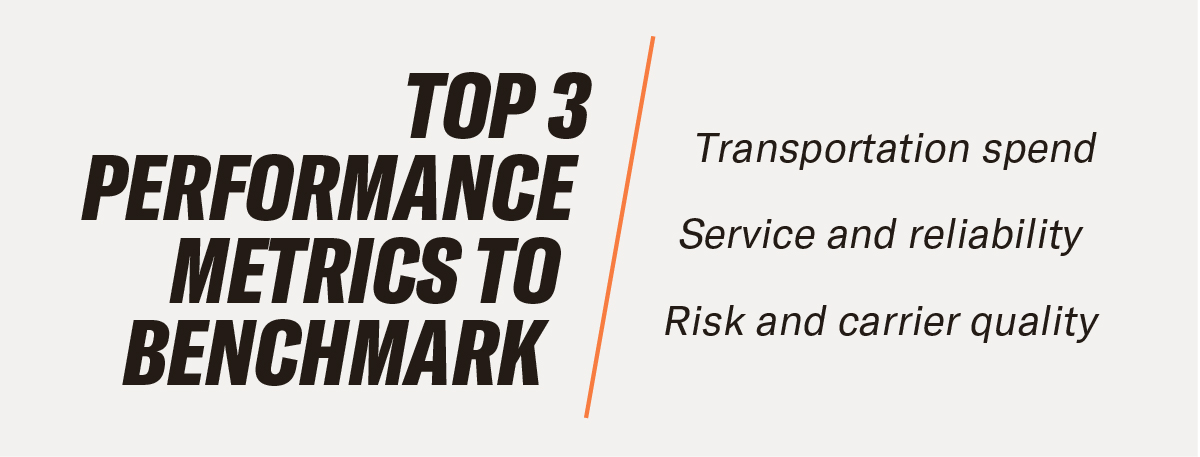
Transportation spend
Transportation spend remains one of the most widely benchmarked supply chain metrics.
One of the most common ways shippers benchmark transportation costs is through market indices such as DAT, which aggregates freight market data from millions of shipments across the industry. These tools can help organizations understand how their transportation costs compare with broader market conditions and identify trends in pricing and spot market activity.
Organizations don't have to rely solely on published benchmarks and market indices. Transportation providers that work across industries often bring broader visibility and expertise into the market and can help organizations:
- Put benchmark results into context
- Understand the factors influencing performance
- Identify realistic opportunities for improvement
Their experience can help shippers move beyond numbers alone and make more informed decisions about their networks.
Fuel costs should also be part of the analysis. Changing fuel prices can significantly impact transportation spend, making it important to understand whether cost increases are being driven by market conditions, operational decisions or both. As fuel prices fluctuate, benchmarking can help organizations identify lanes where more fuel-efficient modes, such as intermodal, may offer a cost advantage.
Service and reliability
Cost is only one side of the equation.
Benchmarking should also evaluate service-related metrics such as on-time performance, carrier acceptance rates and operational consistency. Organizations that focus exclusively on rates may overlook service issues that create hidden costs elsewhere in the supply chain.
Reliable service can support more predictable inventory management, reduce disruptions and help create a more flexible operation that can adapt as transportation conditions change.
Risk and carrier quality
Risk is often one of the least measured but most important benchmarking categories.
Organizations should periodically evaluate factors such as:
- Carrier safety performance
- Insurance coverage
- Operating authority
- Compliance history
- Carrier stability
Many shippers verify these elements when establishing a carrier relationship but rarely revisit them later.
“A carrier that met your standards three years ago may not present the same level of risk today,” notes Wilder. “Regularly reviewing factors such as insurance coverage, operating authority and safety performance can help you make informed decisions about the carriers moving your freight.”
Benchmarking reveals trade-offs, not just savings
One of the biggest misconceptions about benchmarking is that it simply identifies areas to reduce costs. In reality, benchmarking often reveals trade-offs between cost, service, reliability and risk.
A lower transportation rate may look attractive on paper, but if it comes with more service disruptions, lower carrier reliability or increased risk exposure, the total cost to the business may actually increase. Effective benchmarking helps organizations evaluate those competing factors so they can make decisions that support both performance and long-term network stability.
For example:
- Lower transportation costs may require changes to carrier strategy.
- Converting freight to intermodal may reduce costs but alter transit time.
- Consolidating shipments may improve efficiency but require operational adjustments elsewhere in the network.
Benchmarking provides visibility into those trade-offs, allowing organizations to make decisions that align with their business priorities.
Benchmarking only creates value if you're prepared to act
Perhaps the most overlooked aspect of benchmarking has nothing to do with data. It's change management.
According to Wilder, many organizations invest significant time identifying improvement opportunities but struggle to implement them because change can be disruptive or they do not have the technology needed to sustain and measure the improvement.
"Your appetite for change and your ability to implement must absolutely be considered before you invest time and resources into the benchmarking process,” she advises.
The most successful organizations view benchmarking as the beginning of a continuous improvement process, not the final destination. It is often most effective when approached as a collaborative effort across the organization. Once opportunities are identified, stakeholders across transportation, operations, finance and risk management must align around what changes are realistic and how those changes will be implemented.
How can benchmarking be used as a continuous improvement strategy?
Supply chain benchmarking should not be treated as a one-time exercise.
In stable market conditions, Wilder has seen successful organizations benchmark every 12 to 18 months. During periods of significant volatility, more frequent evaluations – perhaps every three to six months – may be beneficial.
As transportation markets continue to change, ongoing benchmarking helps organizations identify emerging risks, understand changing cost drivers and uncover opportunities to improve network performance before problems become disruptions.
Ultimately, supply chain benchmarking isn't about finding a single number. It's about creating the visibility needed to make smarter decisions and build a more flexible, resilient supply chain that can respond confidently to whatever comes next.
From benchmarking to action
Supply chain benchmarking can reveal opportunities to improve performance – but realizing those opportunities requires the right strategy, processes, technology and organizational alignment. The most successful organizations use benchmarking insights not only to measure performance, but to guide continuous improvement and better decision-making.
By helping organizations identify risks, evaluate trade-offs and uncover opportunities before they become pressing challenges, benchmarking can help move supply chains from reacting to market conditions to proactively building a more stable, resilient network.
Save with a proactive supply chain
Find strategies to protect margins, reduce risk and improve performance in this guide.
Related resources
Drive your business forward
Sign up to receive our industry leading newsletter with case studies and insights you can put to use for your business.